
Publicatie Laka-bibliotheek:
Being Nuclear - Africans and the Global Uranium Trade (2012)
| Auteur | G.Hecht |
 | - |
| Datum | 2012 |
| Classificatie | 6.01.2.20/51 (URANIUM - WINNING/VOORRAAD/PRIJS) |
| Voorkant | 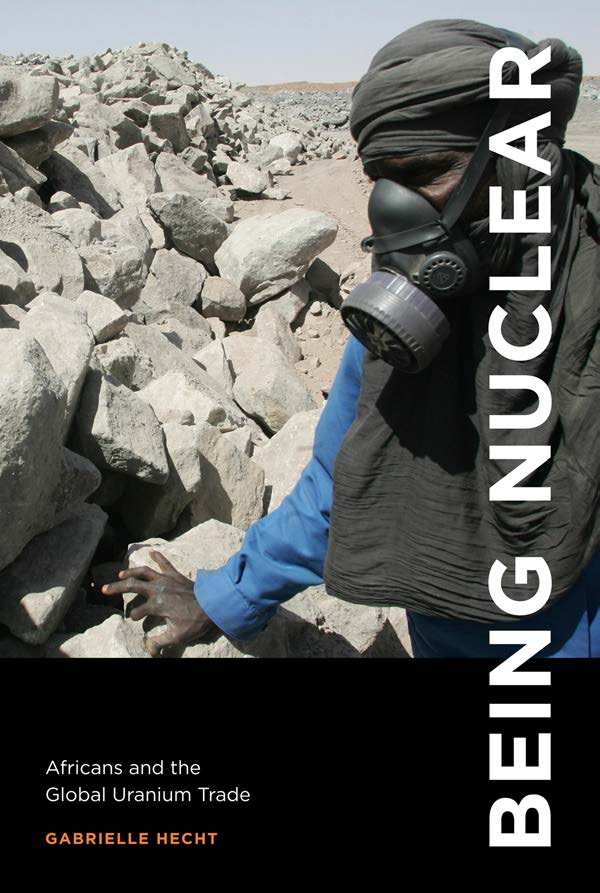 |
Uit de publicatie:
BEING NUCLEAR
AFRICANS AND THE GLOBAL URANIUM TRADE
GABRIELLE HECHT

2012 Massachusetts Institute of Technology

Consider the political and technical parameters of the Bush administration
’ s claims. Officials repeatedly stated that Iraq had sought uranium “ from
Africa. ” Had Saddam been suspected of approaching Kazakhstan, would
they have asserted that he ’ d sought uranium “ from Asia ” ? In the Western
public imagination, Africa remains the “ dark continent, ” mysterious and
politically corrupt — the perfect source for black-market nuclear goods.
Consider also the assumption that acquisition of uranium constituted
prima facie evidence of bomb building. Before uranium attains weapons
grade, it must be mined as ore, processed into yellowcake, converted into
uranium hexafluoride, enriched, and pressed into bomb fuel. “ Uranium ”
is as underspecified technologically as “ Africa ” is politically.
The Niger episode reflects the ambiguities of the nuclear state, and the
state of being nuclear. What exactly is a “ nuclear state ” ? Does a uranium
enrichment program suffice to make one of Iran, as its president Mahmoud
Ahmadinejad claimed in early 2010? Or are atomic bomb tests the deciding
factor, thereby justifying Israel ’ s insistence that it will not be the first
nuclear state in the Middle East? Such ambiguities cannot be dismissed as
doublespeak or grandiose rantings. They matter too much to be discounted
so easily.
The nuclear status of uranium is an important aspect of these ambiguities.
When does uranium count as a nuclear thing? When does it lose that
status? And what does Africa have to do with it? This book argues that
such issues lie at the heart of today ’ s global nuclear order. Or disorder,
as the case may be.
The questions themselves sound deceptively simple. Understanding
their significance and scope requires knowing their history. Yellowcake
from Niger may not have entered Iraq in 2002, but uranium from Africa
was (and remains) a major source of fuel for atomic weapons and power
plants throughout the world. Uranium for the Hiroshima bomb came from
the Belgian Congo. In any given year of the Cold War, between a fifth
and a half of the Western world ’ s uranium came from African places:
Congo, Niger, South Africa, Gabon, Madagascar, and Namibia.
Deze publicatie is digitaal beschikbaar in de Laka-biblitoheek maar de pdf staat niet online.
Mail ons (info@laka.org) als u de pdf toegestuurd wilt krijgen (met onderwerp, volgnummer en titel). U kunt natuurlijk ook langskomen.