
Publicatie Laka-bibliotheek:
Germany, Plutonium & Proliferation -The unstated threat (1995)
| Auteur | M.Küntzel |
| Datum | 1995 |
| Classificatie | 2.01.3.10/14 (DUITSLAND - ONTWIKKELING A-BOM / PLUTONIUMEKONOMIE) |
| Voorkant | 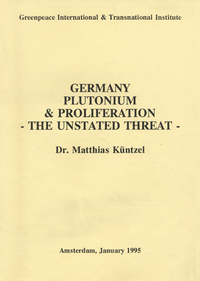 |
Uit de publicatie:
INTRODUCTION

Nuclear proliferation is an issue likely to have a higher profile during 1995 than ever
before. In the post-Cold War world, it is hailed as one of the emerging threats to
global security. In April this year a decision is due to be made on the future of the
NPT or Nuclear Non-Proliferation Treaty. The predominant view in the industrialised
world is that the proliferation threat comes from countries in the South, and it is the
NPT which contains this threat. Consequently, the NPT must be extended - in its
existing form indefinitely. Anything else, this view goes, will lead to greater
proliferation. But the real history of the NPT and nuclear proliferation tells a different
story, and leads to a very different conclusion as to the worth of the Treaty.

In an attempt to broaden the debate over proliferation, this paper summarises the role
played by Germany. A country generally considered not a proliferation threat, and
yet it has played a very distinct role in undermining effective nuclear non-
proliferation. Although the country's nuclear industry has come under international
scrutiny for its poor record in nuclear technology proliferation, its political
establishment has tended to remain unblemished. However, Germany played a key
role in weakening the instruments of the NPT during the drafting of the Treaty
almost 30 years ago. In addition, along with Japan, successive German governments
have defended the right of non-nuclear weapons states to acquire large stockpiles of
weapons-usable plutonium.

It is highly topical at this time to highlight the historical and contempory role
played by Germany in non-proliferation affairs. For in addition to a decision on the
future of the NPT due in 1995, three other issues with major international
implications are in the process of negotiation. Firstly, Germany is currently playing
a lead role in the renegotiation of the US-EURATOM Agreement, which expires at
the end of 1995. Along with the UK and France, Germany is resisting all efforts by
the US to exercise its legitimate control over European nuclear activities. This
should not be surprising as Germany was instrumental during the 1950's in
establishing EURATOM, as a way of excluding US and international safeguards
concerning its nuclear activities. Secondly, the United Nations Conference on
Disarmament in Geneva during 1995 will probably begin negotiations for a halt or
cut-off in fissile materials production- including plutonium. While it is understood
that Germany is leading the call for international control over plutonium within the
arsenals of the nuclear weapons states, it will not volunteer for international control
over its own plutonium stockpile. Efforts to extend the cut-off to include all fissile
material have been rejected by Germany. And finally, as part of the move towards
European defence and foreign policy
harmonization due to be agreed in 1996, a debate has already begun over the
integration of nuclear weapons into a common EU defence policy. The issue of a
European nuclear force, specifically allowed for within the NPT during its drafting
in the 1960's- at the insistence of Germany- has already been quietly resurrected.
Deze publicatie is alleen op papier bij Laka beschikbaar, niet als pdf.
Publicaties zijn te leen of informeer of we een kopie kunnen maken. Soms, als we tijd hebben, lukt dat tegen kostprijs van de kopieën.