
Publicatie Laka-bibliotheek:
Residential proximity to nuclear power plants and cancer incidence in Massachusetts, USA (2000–2018) (2025)
| Auteur | Y.Alwadi, J.S.Evans, J.Schwartz, C.L.Zilli Vieira, D.C.Christiani, B.A.Coull, P.Koutrakis |
 | 6-01-4-60-55.pdf |
| Datum | december 2025 |
| Classificatie | 6.01.4.60/55 (STRALING - GEVOLGEN - ROND INSTALLATIES) |
| Voorkant | 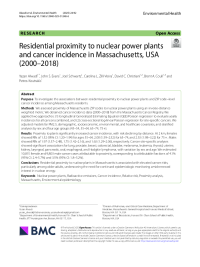 |
Uit de publicatie:
Residential proximity to nuclear power plants and cancer incidence in Massachusetts,
USA (2000–2018)
Environmental Health
Published: 18 December 2025
Volume 24, article number 92, (2025)
Yazan Alwadi, John S. Evans, Joel Schwartz, Carolina L. Zilli Vieira, David
C. Christiani, Brent A. Coull & Petros Koutrakis

Abstract
Purpose

To investigate the associations between residential proximity to nuclear power
plants and ZIP code–level cancer incidence among Massachusetts residents.
Methods

We assessed proximity of Massachusetts ZIP codes to nuclear power plants using an
inverse-distance weighted metric. We obtained cancer incidence data (2000–2018)
from the Massachusetts Cancer Registry. We applied two approaches: (1)
longitudinal Generalized Estimating Equation (GEE) Poisson regression to evaluate
yearly incidences for all cancers combined, and (2) cross-sectional log-linear
Poisson regression for site-specific cancers. We adjusted models for PM2.5,
demographic, socioeconomic, environmental, and healthcare covariates, and
stratified analyses by sex and four age groups (45–54, 55–64, 65–74, 75 +).
Results

Proximity to plants significantly increased cancer incidence, with risk declining
by distance. At 2 km, females showed RRs of 1.52 (95% CI: 1.20–1.94) for ages
55–64, 2.00 (1.59–2.52) for 65–74, and 2.53 (1.98–3.22) for 75 + . Males showed
RRs of 1.97 (1.57–2.48), 1.75 (1.42–2.16), and 1.63 (1.29–2.06), respectively.
Cancer site-specific analyses showed significant associations for lung, prostate,
breast, colorectal, bladder, melanoma, leukemia, thyroid, uterine, kidney, laryngeal,
pancreatic, oral, esophageal, and Hodgkin lymphoma, with variation by sex and age.
 We estimated 10,815 female and 9,803 male cancer cases attributable to proximity,
corresponding to attributable fractions of 4.1% (95% CI: 2.4–5.7%) and 3.5%
(95% CI: 1.8–5.2%).
Conclusions

Residential proximity to nuclear plants in Massachusetts is associated with elevated
cancer risks, particularly among older adults, underscoring the need for continued
epidemiologic monitoring amid renewed interest in nuclear energy.