
Publicatie Laka-bibliotheek:
Radiation: Doses, effects, risks (1985)
| Auteur | UNEP |
| Datum | december 1985 |
| Classificatie | 6.01.4.00/61 (STRALING - ALGEMEEN) |
| Opmerking | See 6.01.4.00/60 |
| Voorkant | 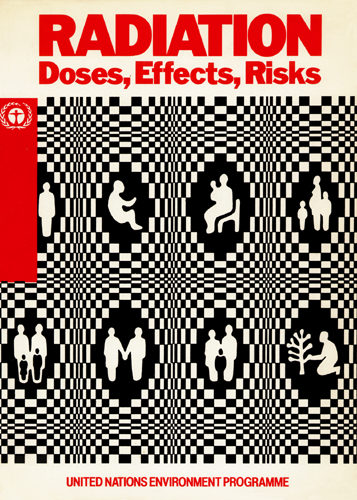 |
Uit de publicatie:
Introduction

Few scientific issues arouse so much public controversy as the effects of radiation.
Scarcely a week seems to go by in developed countries without some expression
of public feeling - and, as some developing countries advance their nuclear
programmes, they may well increasingly have the same experience. There
is little sign that the radiation debate will die down in the near future.
Unfortunately, providing unbiased factual information to the public often takes
second place to propagating opinions. Too often, anti-nuclear activists rely on
emotion; too often, nuclear advocates rely on bland reassurance.
The United Nations Scientific Committee on the Effects of Atomic Radiation
(UNSCEAR) collects available evidence on the sources and effects of radiation,
and evaluates it. It considers a wide range of natural and man-made sources,
and its conclusions may surprise even some who have followed the public
debate quite closely.
Radiation does kill. It causes severe tissue damage at high doses. At low levels
it can cause cancers and induce genetic defects that can affect the children,
grandchildren and later descendants of those irradiated.
Deze publicatie is alleen op papier bij Laka beschikbaar, niet als pdf.
Publicaties zijn te leen of informeer of we een kopie kunnen maken. Soms, als we tijd hebben, lukt dat tegen kostprijs van de kopieën.