
Publicatie Laka-bibliotheek:
Political electricity. What future for nuclear energy? (1995)
| Auteur | T.Price |
| Datum | 1995 |
| Classificatie | 6.01.0.20/100 (BELANG MONDIAAL) |
| Voorkant | 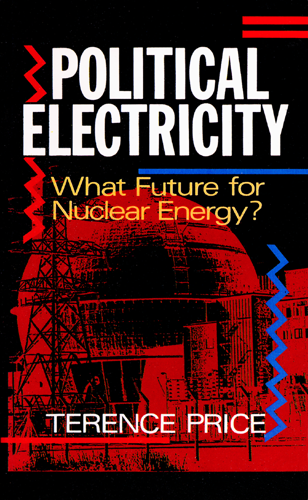 |
Uit de publicatie:
Preface

This book, written from the safe haven of recent retirement, is a personal and-so far
as possible-non-technical exploration of the political and policy issues that have
influenced the development of nuclear power. Part One describes the successes,
failures, horse-trading, and infighting that make up nuclear power's history, taking
nine countries as examples. Part Two reviews the main problems that now confront
us. I make no claim to be exhaustive: a definitive nuclear history of the past thirty
to forty years would require a dozen volumes this size. In any case, like all
contemporary accounts, the book is unavoidably incomplete, since history did not
stop at my cut-off date, June 1990. By then, fortunately, it was possible to make
provisional judgements about two very important recent influences: the political
consequences of Chernobyl, and concerns about the greenhouse effect. The Iraqi
invasion of Kuwait came too late for inclusion, though the instability of the Middle
East, its restored dominance in oil production, the inroads nuclear power has made
into the oil market, and its contribution to energy supply diversity are all recurring
themes.
The story that emerges is of a nuclear industry that has rarely been guilty of
dereliction of duty, though it was undeniably complacent in not addressing sooner
the causes of the public's entirely reasonable anxieties. The anti-nuclear lobby has
been skilled in debate, and sometimes extraordinarily percipient; but less than fair
in failing to acknowledge the industry's achievements and its willingness to learn
from past mistakes. As for the politicians, the book contains many examples that
show how the flames of controversy can be deliberately fanned when there are votes
to be gained. The story has few heroes, but within the industry fewer villains than
the public has been led to believe. I hope that my anecdotal selection of events and
issues may help readers to form their own judgements, and make it a little harder
for glib assertions, from whatever quarter, to go unchallenged.
It was difficult to decide what to exclude because of the exigencies of space, and
it was with considerable regret that I limited myself to only a passing reference to
the USSR, and then only in the context of the Chernobyl disaster.
Deze publicatie is alleen op papier bij Laka beschikbaar, niet als pdf.
Publicaties zijn te leen of informeer of we een kopie kunnen maken. Soms, als we tijd hebben, lukt dat tegen kostprijs van de kopieën.