
Publicatie Laka-bibliotheek:
Fiscal Fission: Economic failure of Nuclear Power (1992)
| Auteur | Komanoff Energy Associates |
| Datum | december 1992 |
| Classificatie | 6.01.0.10/40 (KOSTEN) |
| Voorkant | 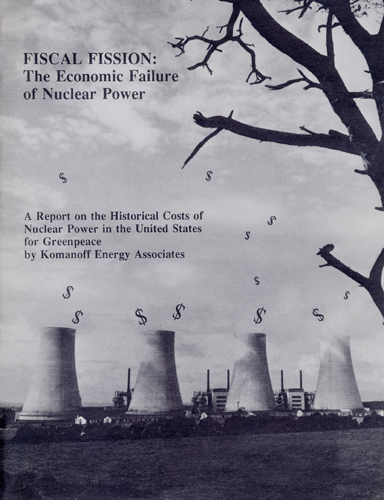 |
Uit de publicatie:
PREFACE

by Charles Komanoff

In May 1979, six weeks after the meltdown at Three Mile Island, Ralph Nader
assailed nuclear power as fundamentally "too unsafe, too expensive and too
unnecessary.'' Events in the intervening years have confirmed Ralph's
pronouncement- the Chernobyl disaster, investor losses from reactor cost
overruns, and the emergence of an energy-efficiency profit center within the
utility industry, to name a few. As safe energy activists have grasped from the
beginning - long before Three Mile Island - nuclear power's lack of safety,
economics and necessity go together.

The fundamental nature of nuclear technology - the very radioactivity and energy
density that mesmerized the first atomic physicists - makes it inherently dangerous
and in need of an unprecedented and unaffordable degree of physical and social
control. Nuclear power's high cost, in turn, undermines the need for it, as users,
inventors and institutions develop more effective technologies and - yes - lifestyles,
that allow us to function without it.

October 1993 will mark the 20th anniversary of the last order for a commercial
U.S. nuclear power plant that made it through the pipeline. Old reactors are being
retired faster than new ones are being brought on line. Capital that previously was
funneled to new power plants is financing efficient light bulbs and machinery in
factories, homes and offices. Increasingly, energy studies at the local, state, national
and international levels are mapping energy paths that reduce fossil fuel use without
nuclear power. Progressive utilities are coming to realize that their future lies in
providing "least-cost" electricity services through maximal end-use efficiency.

Today, thanks to a resourceful safe energy movement, nuclear power is at bay.
Nevertheless, while the reality of nuclear power grows ever dimmer, the idea of it
refuses to die. Federal officials and reactor corporations persist in trying to dictate
a nuclear future for U.S. energy policy. Through their influence, several hundred
million federal taxpayer dollars still go each year to concoct new reactor models
that, they promise, will be miraculously free of the problems that have plagued the
hundred-or-so still running.
Deze publicatie is alleen op papier bij Laka beschikbaar, niet als pdf.
Publicaties zijn te leen of informeer of we een kopie kunnen maken. Soms, als we tijd hebben, lukt dat tegen kostprijs van de kopieën.