
Publicatie Laka-bibliotheek:
Radiation and indigenous populations: the Marshall Islands case (1993)
| Auteur | G.Alcalay |
| Datum | juni 1993 |
| Classificatie | 4.26.4.00/20 (PACIFIC - PROEFGEBIED VS) |
| Voorkant | 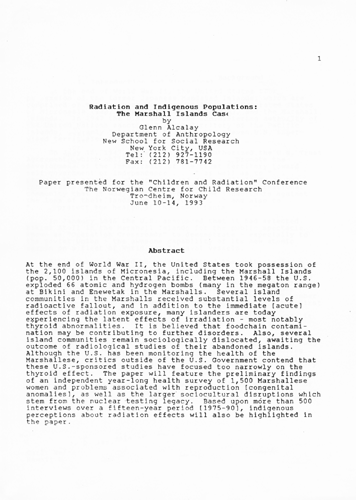 |
Uit de publicatie:
Abstract

At the end of World War II, the United States took possession of the 2,100 islands
of Micronesia, including the Marshall Islands (pop. 50,000) in the Central Pacific.
Between 1946-58 the U.S. exploded 66 atomic and hydrogen bombs (many in the
megaton range) at Bikini and Enewetak in the Marshalls. Several island communities
in the Marshalls received substantial levels of radioactive fallout, and in addition
to the immediate [acute] effects of radiation exposure, many islanders are today
experiencing the latent effects of irradiation - most notably thyroid abnormalities.
It is believed that foodchain contamination may be contributing to further disorders.
Also, several island communities remain sociologically dislocated, awaiting the
outcome of radiological studies of their abandoned islands. Although the U.S. has
been monitoring the health of the Marshallese, critics outside of the U.S. Government
contend that these U.S.-sponsored studies have focused too narrowly on the thyroid
effect. The paper will feature the preliminary findings of an independent year-long
health survey of 1,500 Marshallese women and problems associated with
reproduction [congenital anomalies], as well as the larger sociocultural disruptions
which stem from the nuclear testing legacy. Based upon more than 500 interviews
over a fifteen-year period (1975-901, indigenous perceptions about radiation effects
will also be highlighted in the paper.
Deze publicatie is alleen op papier bij Laka beschikbaar, niet als pdf.
Publicaties zijn te leen of informeer of we een kopie kunnen maken. Soms, als we tijd hebben, lukt dat tegen kostprijs van de kopieën.