
Publicatie Laka-bibliotheek:
Japan's Plutonium. A Major Threat to the Planet (Rokkasho) (1992)
| Auteur | Plutonium Free Future |
| Datum | juni 1992 |
| Classificatie | 4.21.8.30/02 (JAPAN - ROKKASHO REPROCESSING PLANT) |
| Voorkant | 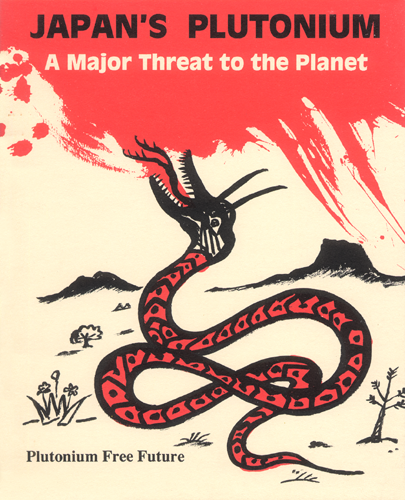 |
Uit de publicatie:
HELP STOP
Japan's Plutonium Energy Drive

SOS

Radioactive pollution from nuclear power plants poses one of the most serious
threats to life on earth. This is evident in the continuing effects of the Chernobyl
accident of 1986. Among radioactive substances, plutonium has the potential of
being the most hazardous to humans and the environment
The Japanese government's plans for large scale plutonium-based energy production
puts the entire planet in grave danger; however, there is little public awareness of
this issue outside of Japan. We want the world to know about Japan's plutonium
policy, and the risk of nuclear contamination and disaster on an unprecedented level.
We urge you to help make this a top-priority environmental issue for the world.

What Is Plutonium?

Plutonium, unlike uranium, is not found in nature; it is produced in the process of
burning uranium in nuclear reactors. Its destructive power is far greater than that
of uranium. As long as nuclear power plants operate in the world, plutonium will
continue to be produced. If it enters a human body, it will sit in the lungs, bones
and tissue, causing cancer and destroying cells and genes. Just one billionth of an
ounce of plutonium exceeds the permissible intake of a person, and it has a half-life
of 24,000 years. This is the most toxic radioactive substance on earth.
Named after Pluto, king of Hades in Greek mythology, plutonium was discovered
in the United State and was first used in the atomic bomb dropped in Nagasaki in
1945. Besides being an essential material for nuclear weapons, plutonium has also
been promoted as fuel for generating electric power. Extensive plutonium-related
research has been carried out in various countries; however the social and
environmental impact of its large-scale use has never been fully assessed.
Deze publicatie is alleen op papier bij Laka beschikbaar, niet als pdf.
Publicaties zijn te leen of informeer of we een kopie kunnen maken. Soms, als we tijd hebben, lukt dat tegen kostprijs van de kopieën.