
Publicatie Laka-bibliotheek:
A study of cancer incidence in Lawrence Livermore Laboratory employees. Report #1 Malignant Melanoma (1980)
| Auteur | D.F.Austin |
| Datum | april 1980 |
| Classificatie | 3.01.8.45/04 (VS - LOCATIES - LAWRENCE LIVERMORE NATIONAL LAB (LLNL)) |
| Voorkant | 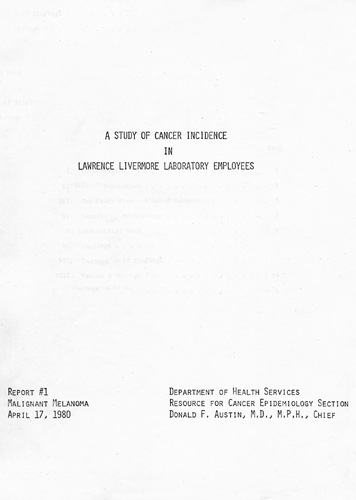 |
Uit de publicatie:
INTRODUCTION

In late 1976 the Resource for Cancer Epidemiology (RCE) received reports from
local clinicians specializing in treating malignant melanoma that an unusual number
of their melanoma patients were employees of the Lawrence Livermore Laboratory
(LLL). Simultaneously and independently, Dr. Max Biggs, Chief of Medical Services
at LLL, began gathering information to help determine whether or not employees at
LLL were experiencing an unusual risk of melanoma. In subsequent discussions
between Dr. Donald Austin, Chief of the RCE, and Dr. Biggs of LLL it was agreed
that the two agencies would cooperate in conducting a scientific evaluation of
melanoma occurrence at LLL. By July, 1977, initial planning for the study and
negotiations for the necessary employee data files with which to conduct the study
were completed. A summary tape of computer files describing the persons employed
at the laboratory was subsequently delivered by LLL to the RCE to begin the study.

During the months when review of the files and work on the data summary and
analysis plans proceeded the RCE found it necessary to request a second set of files,
the annual employee roster, from LLL. These files were also submitted to the RCE for
analysis in the fall of 1978.

Slow progress was made during the initial processing of the employee files and the
preliminary examination of melanoma incidence rates and trends in Alameda County.
Staff assigned to this work were borrowed, on a part-time basis, from other projects.
During this process it became clear that the appropriate analysis would require that
a more complex method for computing the "expected" numbers of cases among LLL
employees be developed than was originally planned. The analytic method selected
had to control for possible effects related to the specific place of residence of the
employees since this was found to affect melanoma incidence. The resulting study
design was established to avoid the possible effects of confounding variables related
to residence. Adjustment for these factors required the development of several
computer software packages to calculate accurate population estimates by age, race
and sex for census tracts containing resident LLL employees, to compute person years
of observation for the LLL employees by year, sex, age and census tract of residence.

The crucial objective was to determine whether or not an unusual number of
melanoma cases were occurring among the LLL employees. In establishing the study
design, the prevailing philosophy was that every effort should be made to make the
initial comparisons of observed vs expected cases of melanoma in the employee
group as accurate as possible rather than to economize on time and compromise
the study by producing a crude risk estimate of dubious scientific value.
Deze publicatie is alleen op papier bij Laka beschikbaar, niet als pdf.
Publicaties zijn te leen of informeer of we een kopie kunnen maken. Soms, als we tijd hebben, lukt dat tegen kostprijs van de kopieën.