
Publicatie Laka-bibliotheek:
Statistical analyses of cancer incidence patterns in the Denver metropolitan area in relation to the Rocky Flats plant (1984)
| Auteur | K.S.Cramp, T. Ng, R.G.Cuddihy |
| Datum | augustus 1984 |
| Classificatie | 3.01.8.44/10 (VS - LOCATIES - ROCKY FLATS) |
| Voorkant | 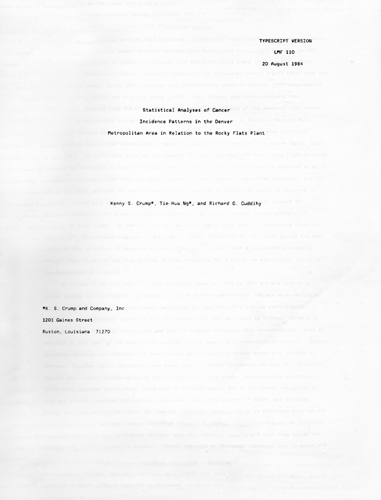 |
Uit de publicatie:
EXECUTIVE SUMMARY

Two reports appeared in 1981 that indicated a statistical relationship exists between
cancer incidence patterns in the Denver Standard Metropolitan Statistical Area
(SMSA) for 1969 to 1971 and soil concentrations of plutonium released from the
Rocky Flats plant (Johnson 1981, Chinn 1981). These studies used cancer incidence
statistics for individual census tracts taken from the Third National Cancer Survey
and plutonium soil concentration contours derived from measurements reported by
Krey (1976) and Krey and Hardy (1970). Both Johnson and Chinn concluded that
radioactivity released from the Rocky Flats plant was a likely cause of the observed
high cancer incidences in populations living near the plant. This relationship is
doubtful because (a) analyses of tissues obtained from autopsies of Denver area
residents did not show plutonium concentrations higher than those found in people
living in other areas of the United States (Cobb et al. 1982), (b) sufficient time
had not elapsed for plutonium released from Rocky Flats to cause the observed
increases in cancer incidences during 1969 to 1971; (c) the cancers reported to be
in excess included many types that are likely to result from internally deposited
plutonium, and (d) cancer incidence patterns for men and women are not typical
of those that would be expected if they were caused by a single environmental factor.
However, because of public concern for radiation exposures, the present study was
undertaken to further explore cancer patterns in relation to Rocky Flats. In addition
to the cancer incidence data used by Johnson and Chinn for 1969 to 1971, we
analyzed data for 1979 to 1981. Cancer incidences for the later period are more
likely to show an effect of exposure to Rocky Flats plutonium if such a relationship
actually exists. This is due to the long periods of time necessary for a radiation
exposure to result in the development of a cancer.
Deze publicatie is alleen op papier bij Laka beschikbaar, niet als pdf.
Publicaties zijn te leen of informeer of we een kopie kunnen maken. Soms, als we tijd hebben, lukt dat tegen kostprijs van de kopieën.