
Publicatie Laka-bibliotheek:
Missing the Path to "Cleanup": False economic assumptions and failed contracting practices (1998)
| Auteur | Alliance for Nuclear Accountability |
| Datum | mei 1998 |
| Classificatie | 3.01.5.30/36 (VS - KERNWAPENFABRIEKEN EN SCHOONMAAK) |
| Voorkant | 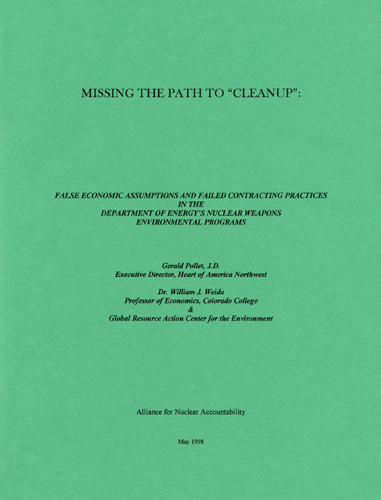 |
Uit de publicatie:
MISSING THE PATII TO "CLEANUP"

FALSE ECONOMIC ASSUMPTIONS AND FAILED CONTRACTING PRACTICES IN THE DEPARTMENT
OF ENERGY'S NUCLEAR WEAPONS ENVIRONMENTAL PROGRAM

By:
Gerald Pollet, J.D.
Executive Director, Heart of America Northwest
Dr. Bill Weida
Professor of Economics, Colorado College, & Global Resource Action Center
for the Environment

This document is part of a series of reports by the Alliance for Nuclear
Accountability (ANA) on the Department of Energy's Environmental Management
program. The first in the Missing the Path to "Cleanup" series, the "Root Causes of
the Failures in the U.S. Department of Energy's Nuclear Weapons Environmental
Program" analyzed the underlying factors that contribute to the failures of the
program. This report critiques some of the economic assumptions upon which the
Department of Energy (DOE) bases its current plan. (1) In addition, this series of
reports is intended to serve as ANA's comments on the DOE's "Accelerating Cleanup:
Paths to Closure" document.

ANA finds that DOE's economic assumptions and proposals in its "Accelerating
Cleanup Program" create a plan that fails to meet basic safety and remediation
obligations and wastes billions of taxpayer dollars. ANA presents an alternative
financial and management blueprint which allows for more than $6 billion of
additional cleanup work to be done through Fiscal Year 2006 for the same total
budget.

If the nation is going to meet its moral and legal commitments to protect the public
health and environment of the regions surrounding the Department of Energy's
nuclear weapons complex sites, massive economic, management and contract
reforms must reshape the nuclear weapons complex environmental management
program.

The DOE's current management practices, budget assumptions, and contracting
strategies are a blueprint for catastrophic releases of nuclear and toxic wastes.
The program assumes leaving behind unacceptably high levels of residual
contamination - levels that will condemn future exposed populations to fatal
cancer risks that we cannot accept as a nation.

The DOE has produced a "strategic plan" or blueprint for addressing the most
contaminated places in America, the sites where nuclear weapons and their
components

(1) The "Accelerating Cleanup Program" will be used when referring to the plan
which has gone by three different names in the last year. When referring to a
specific draft, the document will be noted by name (the three versions are the
Ten Year Plan, the Accelerating Cleanup: Focus on 2006 Plan, and Accelerating
Cleanup: Paths to Closure)
Deze publicatie is alleen op papier bij Laka beschikbaar, niet als pdf.
Publicaties zijn te leen of informeer of we een kopie kunnen maken. Soms, als we tijd hebben, lukt dat tegen kostprijs van de kopieën.