
Publicatie Laka-bibliotheek:
Plutonium: the First 50 Years. US' plutonium production, acquisition, and utilization from 1944 to 1994 (1996)
| Auteur | Department Of Energy |
| Datum | februari 1996 |
| Classificatie | 3.01.5.30/06 (VS - KERNWAPENFABRIEKEN EN SCHOONMAAK) |
| Voorkant | 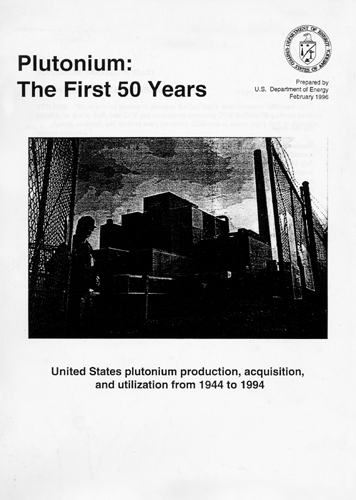 |
Uit de publicatie:
2. INTRODUCTION

The breakup of the Soviet Union and the end of the Cold War has allowed the U.S.
to reconsider its classification and declassification policies and practices. The release
of this report is a result of new declassification initiatives, President Clinton's goal
for greater openness in government, and commitments made by Secretary of Energy
O'Leary at the June 27, 1994, Openness Press Conference.

This report covers the first 50 years of DOE plutonium activities, from the beginning
of plutonium production by the Manhattan Engineer District in 1944 through
September 1994. The report contains important newly declassified information
regarding the U.S. production, acquisition, and removals of plutonium. This new
information, when combined with previously declassified data, has allowed the DOE
to issue, for the first time, a truly comprehensive report on the total DOE/DoD
plutonium inventory.

The DOE believes that this report will aid in discussions of plutonium storage,
safety, and security with stakeholders as well as encourage other nations to
declassify and release similar data. These data will also be available for
formulating policies with respect to disposition of excess nuclear materials.

Almost all of the information that was used to create this report came from the
Nuclear Materials Management and Safeguards System (NMMSS). It is the official
U.S. nuclear materials accounting system and is used to track U.S. nuclear material
inventories, maintain compliance with the Nuclear Nonproliferation Treaty, and
support International Atomic Energy Agency (IAEA) safeguards. When NMMSS
data were not available, historical reports and memoranda were used.

This report attempts to strike a balance between national security and openness.
The philosophy of declassification and release of information has evolved
dramatically over time. In the 1940's, almost every aspect of U.S. atomic energy
programs was classified. Following World Warn, an effort was made to remove
many of the classification constraints covering information on nuclear chemistry,
metallurgy and physics, and initial declassification efforts were begun in the areas
of nuclear weapons, tests, reactors, materials production, and weapon design and
utilization data.
Deze publicatie is alleen op papier bij Laka beschikbaar, niet als pdf.
Publicaties zijn te leen of informeer of we een kopie kunnen maken. Soms, als we tijd hebben, lukt dat tegen kostprijs van de kopieën.