
Publicatie Laka-bibliotheek:
State of the Environment: Country overview -Ukraine (1998)
| Auteur | TACIS |
| Datum | juni 1998 |
| Classificatie | 2.41.0.00/08 (OEKRAÏNE - ALGEMEEN) |
| Voorkant | 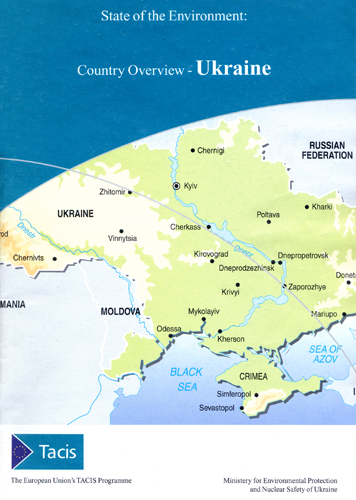 |
Uit de publicatie:
Introduction

The Socio-Economic Context in Ukraine in 1996

1991-1995 saw a significant downturn in the Ukrainian economy. Gross Domestic
Product (GDP) fell by 57%, national income by 59.1%, the budget deficit reached
4.5% of GDP, and consumer prices rocketed 12,000-fold. Extremely negative trends
appeared in GDP structure. Income and wages (the largest share in GDP) are still
declining steadily. The specific proportions of gross and mixed income dropped
from 44.6% in 1991 to 35.9% in 1996, and wages from 58.8% to 44.9%. Even
opportunities for small-scale capital renewal have narrowed due to the reduction
of fixed capital amortization in GDP, which reached a critically low threshold
substantially affecting environmental protection from industrial threats.

The wage proportion in GDP dropped from 53.1% in 1990 to 44.9% in 1996.
As a result, consumption of welfare and services among the population decreased
1.7 times from 1991 to 1996, negatively affecting living standards. The share of
basic food expenditures in total family incomes increased from 38% in 1991 to
57% in 1996, while basic food consumption per capita is consistently declining.
The structure of food consumption shows a steady increase in the proportion of
vegetable foods consumed, with a 1.4-fold decrease in the protein calorie content
in the population's diet.

However, there have also been some positive changes along with the above,
including an increase in the specific share of public utilities in GDP, a fall in the
inflation index to 139% in 1996 as compared to 281.7% in 1995, and considerably
more in previous years (10255% in 1993,501% in 1994). Retail price inflation for
foodstuffs and other consumer goods has dropped significantly. A wider range of
goods is available, monetary credit is reviving up to a point, banking, currency
financial and customs systems are becoming re-established, together with
competitive external trade relations.

The employed population remained practically constant in 1991-1996, although
there has been a drop in total numbers employed in formal economic sectors, certain
industrial branches and the public utilities sector, for example. The jobless
population on 1 January 1996 amounted to 351 100, or 1.3% of the total active
population. Workers accounted for 50.8% of the jobless total, and office personnel
for 43.7%.

The situation regarding real earnings remains strained, and the gap between incomes
is increasing. According to official data only, the average monetary income of the
richest 10% of citizens was more than 6. 7 times higher than that of the 10% with the
lowest incomes, 9 times higher in 1994, and 12 times higher by the end of 1995 (but
37 times higher that year according to data from independent experts); by the end
1996, 10% of the citizens with the highest income were receiving one third of the
total income of the population as a whole. Real incomes fell by 17% in 1996.
Deze publicatie is alleen op papier bij Laka beschikbaar, niet als pdf.
Publicaties zijn te leen of informeer of we een kopie kunnen maken. Soms, als we tijd hebben, lukt dat tegen kostprijs van de kopieën.