
Publicatie Laka-bibliotheek:
Protracted Radiation Exposure and Cancer Mortality in the Techa River Cohort (2005)
| Auteur | L.Yu. Krestinina, RRS |
| Datum | 2005 |
| Classificatie | 2.34.8.80/14 (RUSLAND - MAYAK/TSJELIABINSK (incl. ramp Oeral 1957)) |
| Voorkant | 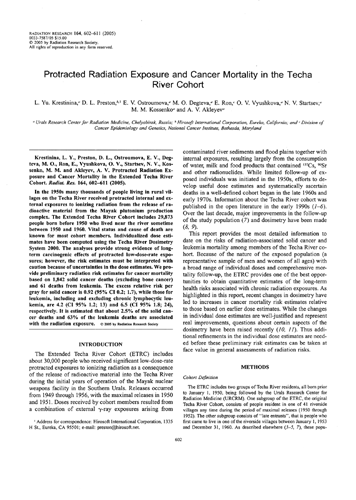 |
Uit de publicatie:
Protracted Radiation Exposure and Cancer Mortality in the Techa River Cohort

INTRODUCTION

The Extended Techa River Cohort (ETRC) includes about 30,000 people who
received significant low-dose-rate protracted exposures to ionizing radiation as a
consequence of the release of radioactive material into the Techa River during the
initial years of operation of the Mayak nuclear weapons facility in the Southern
Urals. Releases occurred from 1949 through 1956, with the maximal releases in 1950
and 1951. Doses received by cohort members resulted from a combination of external
y-ray exposures arising from contaminated river sediments and flood plains together
with internal exposures, resulting largely from the consumption of water, milk and
food products that contained 137Cs, 90Sr and other radionuclides. While limited
follow-up of exposed individuals was initiated in the 1950s, efforts to develop useful
dose estimates and systematically ascertain deaths in a well-defined cohort began in
the late 1960s and early 1970s. Information about the Techa River cohort was
published in the open literature in the early 1990s (1-6). Over the last decade, major
improvements in the follow-up of the study population (7) and dosimetry have been
made (8, 9).
This report provides the most detailed information to date on the risks of radiation-
associated solid cancer and leukemia mortality among members of the Techa River
cohort. Because of the nature of the exposed population (a representative sample of
men and women of all ages) with a broad range of individual doses and
comprehensive mortality follow-up, the ETRC provides one of the best opportunities
to obtain quantitative estimates of the long-term health risks associated with chronic
radiation exposures. As highlighted in this report, recent changes in dosimetry have
led to increases in cancer mortality risk estimates relative to those based on earlier
dose estimates. While the changes in individual dose estimates are well-justified and
represent real improvements, questions about certain aspects of the dosimetry have
been raised recently (10, 11). Thus additional refinements in the individual dose
estimates are needed before these preliminary risk estimates can be taken at face
value in general assessments of radiation risks.
Deze publicatie is alleen op papier bij Laka beschikbaar, niet als pdf.
Publicaties zijn te leen of informeer of we een kopie kunnen maken. Soms, als we tijd hebben, lukt dat tegen kostprijs van de kopieën.