
Publicatie Laka-bibliotheek:
The case against nuclear waste dumping (1990)
| Auteur | Scotland Against Nuclear Dumping |
| Datum | november 1990 |
| Classificatie | 2.05.4.10/24 (GROOT-BRITTANNIË - AFVAL) |
| Voorkant | 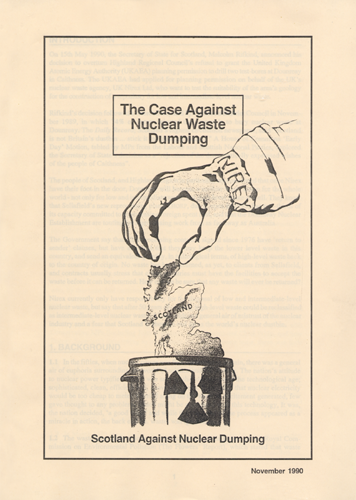 |
Uit de publicatie:
INTRODUCTION

On 15th May 1990, the Secretary of State for Scotland, Malcolm Rifkind, announced
his decision to overturn Highland Regional Council's refusal to grant the United
Kingdom Atomic Energy Authority (UKAEA) planning permission to drill two test-
bores at Dounreay in Caithness. The UKAEA had applied for planning permission
on behalf of the UK's nuclear waste agency, UK Nirex Ltd, who want to test the
suitability of the area's geology for the construction of a repository for low and
intermediate-level nuclear waste.

Rifkind 's decision followed a referendum, held by Caithness District Council in
November 1989, in which 74% of voters rejected the proposals to bury nuclear
waste at Dounreay. The Daily Record, Scotland's highest circulation newspaper,
said "Scotland is not Britain's dustbin ... stick it in Trafalgar Square." A House of
Commons 'Early Day' Motion, tabled by MPs from the Labour and Scottish National
Parties, deplored the Secretary of State's decision as a "rejection of the
democratically expressed wishes of the people of Caithness".

The people of Scotland, and Highland Region in particular, are concerned that once
Nirex have their foot in the door, Dounreay will become a nuclear waste dump for
the whole world- not only for low and intermediate waste, but high-level waste as
well. They know that Sellafield's new reprocessing plant, THORP, due to open in
1993, has two-thirds of its capacity committed to reprocessing foreign spent fuel,
and that the Dounreay Nuclear Establishment are touting for reprocessing work
from as far away as Australia.

The Government say that all reprocessing contracts signed since 1976 have 'return to
sender' clauses, but have admitted that they may keep the lower level waste in this
country, and send an equivalent quantity, in radiological terms, of high-level waste
back to the country of origin. No waste has been returned, as yet, to clients from
Sellafield, and contracts usually stress that client countries must have the
facilities to accept the waste before it can be returned. How can we be sure that
any waste will ever be returned?

Nirex currently only have responsibility for the disposal of low and intermediate-
level nuclear waste, but say that after 50 years of cooling, high-level waste could
be reclassified as intermediate-level nuclear waste. All this adds to a general air
of mistrust of the nuclear industry and a fear that Scotland is about to end up as
the world's nuclear dustbin.
Deze publicatie is alleen op papier bij Laka beschikbaar, niet als pdf.
Publicaties zijn te leen of informeer of we een kopie kunnen maken. Soms, als we tijd hebben, lukt dat tegen kostprijs van de kopieën.