
Publicatie Laka-bibliotheek:
First report from the Environment Committee - Radioactive waste vol.1 (1986)
| Auteur | House of Commons |
| Datum | 1986 |
| Classificatie | 2.05.4.10/21 (GROOT-BRITTANNIË - AFVAL) |
| Voorkant | 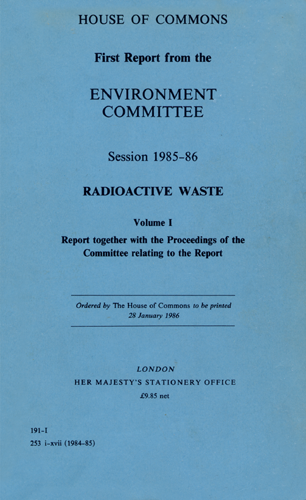 |
Uit de publicatie:
FIRST REPORT

The Environment Committee has agreed to the following Report:

RADIOACTIVE WASTE
CHAPTER 1: INTRODUCTION
THE GROWING PUBLIC AWARENESS

1. Since 1945 the fear of nuclear radiation has developed into an anxiety as deep-
rooted in twentieth century western culture as was the case with electricity in the
nineteenth. Radiation is for most people inexplicable, unseeable, untouchable, and
almost mystically evil in its association with the appalling destructive power of
atomic weapons. It is also associated with that other great twentieth century fear-
cancer. Most frightening of all are the unknown effects, the genetic changes which
might pass on to future innocent generations. It is hardly surprising if the public's
view of things nuclear is at times emotional rather than rational.

2. The development of civil nuclear power in the 1950s alleviated these anxieties for
a while, as it gave reassurance that the terrifying forces could be harnessed for
mankind's good. In the 1970s, however, an awareness grew that the benevolence of
civil nuclear power was tainted by some of the malevolence of its parent, manifested,
primarily, as radioactive waste. The last two years have seen public awareness in
the UK focus on the problems of radioactive waste, as a result of a series of incidents.
In the summer of 1983 the National Union of Seamen and other transport unions
decided to boycott radioactive wastes destined for dumping at sea.(1) Their action
resulted in the setting up of an independent panel of scientists under the chairmanship
of Professor F G T Holliday to investigate the safety of the North Atlantic sea dump.
The Holliday report was published in December 1984.(2) In October 1983 NIREX (3)
identified a disused anhydrite mine at Billingham, Cleveland as a possible site for
the disposal of intermediate-level wastes and Elstow, Bedfordshire as a possible site
for the disposal of low-level and some intermediate-level wastes. Billingham was
subsequently dropped. In November 1983 an "incident leading to contamination of
beaches in the region of Sellafield occurred". (4) In late 1984 the Black Committee
reported on possible health effects in the West Cumbria area.(5) In July 1985 British
Nuclear Fuels plc (BNFL) was convicted on a number of criminal charges brought
against it relating to discharges to sea during the November 1983 "incident". All
these events have given rise to much press comment and considerable public interest
and debate. In addition, two further important events are awaited with interest: the
publication by the Department of the Environment of the results of their study of the
Best Practicable Environmental Options and the report of Sir Frank Layfield QC,
Chief Inspector at the record-breaking Sizewell" B" public inquiry. Few days go by
when an item related to radioactive waste does not appear somewhere in the press. It
is a live and growing issue.
(1) Ev. p 412.
(2) Report of the Independent Review of Disposal of Radioactive Waste in
the Northeast Atlantic, HMSO 1984.
(3) Nuclear Industry Radioactive Waste Executive.
(4) Ev. p 175.
(5) Investigation of the PQssible Increased Incidence of Cancer in West Cumbria:
Report of the Independent Advisory Group, HMSO 1984.
Deze publicatie is alleen op papier bij Laka beschikbaar, niet als pdf.
Publicaties zijn te leen of informeer of we een kopie kunnen maken. Soms, als we tijd hebben, lukt dat tegen kostprijs van de kopieën.