
Publicatie Laka-bibliotheek:
Near miss. Report on what was nearly nuclear disaster (1982)
| Auteur | Agenor |
| Datum | 1982 |
| Classificatie | 2.02.8.10/08 (FRANKRIJK - LA HAGUE - ALGEMEEN) |
| Voorkant | 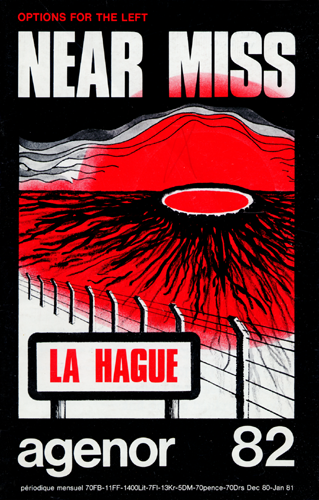 |
Uit de publicatie:
The starting-point for this pamphlet is the little-known events of April 15 1980,
when western Europe came within an ace of a terrible nuclear disaster. The story
of what happened, and what nearly happened, that day at the nuclear waste
re-processing site near Cherbourg, on the French Channel coast, was successfully
hushed up.

We think the truth about La Hague needs to be more widely known. Not only the
true story of that accident and a series of others, before and since (including the fire
in January 1981 which resulted in heavy contamination in the surrounding area), but
also the truth about working conditions, as safety is cynically sacrificed to profit.
nd above all the truth about the failure of the industrial technique of extracting
plutonium from highly-irradiated nuclear waste.

We have argued consistently, since the agenor hearings in Brussels in 1975, against
further recourse to atomic power. In this pamphlet we shall not take up all the
arguments again in detail. We have said that producing electricity using nuclear
reactors is a wrong choice for a wide range of reasons. The risks to the health and
safety of both the workers involved and the rest of the population are too great. The
waste disposal problem, still unsolved, adds risks for future generations which we
have no right to impose. Economically, the nuclear power industry would not be
viable but for the public money pumped into the atomic weapons side. In energy
terms, the yields are low, and in some cases non-existent. Recourse to nuclear
electricity is part of the trend that has done away with millions of jobs. Politically,
the spread of civil uses is inseparable from the proliferation of atomic weapons, and
within our countries it helps to boost the police state. The vast sums sucked into the
nuclear gamble could and should be switched to energy conservation and the
development of safe, renewable energy sources, which will also create more jobs.
It is in this overall context that the story of La Hague - and the equally disquieting
story of the British reprocessing plant at Windscale - should be seen.
Deze publicatie is alleen op papier bij Laka beschikbaar, niet als pdf.
Publicaties zijn te leen of informeer of we een kopie kunnen maken. Soms, als we tijd hebben, lukt dat tegen kostprijs van de kopieën.