
Publication Laka-library:
Grassroots- How to fight Nuclear Power and Win! (1980)
| Author | Fr.Wilcox |
| Date | 1980 |
| Classification | 3.01.2.19/04 (UNITED STATES - ANTI NUCLEAR MOVEMENT / ACTIONS / REPRESSION) |
| Front | 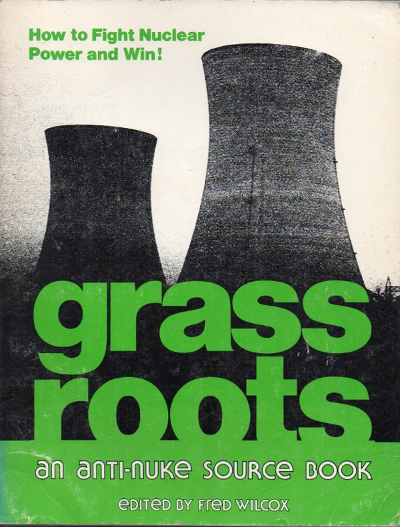 |
From the publication:
PREFACE

Following the near meltdown at Three Mile Island a nonpartisan committee was
established to investigate the accident and make recommendations to the President.
The Committee concluded that the Nuclear Regulatory Commission had been remiss
in handling the crises at TMI and that the Commission should be abolished, but the
investigators were unable to reach a consensus for declaring a moratorium on nuclear
power. President Carter did not abolish the NRC, nor did the commissioners resign en
masse, though they did declare a six month moratorium on issuing construction or
operating permits for nuclear reactors. Shortly after the NRC's decision Congress
voted against a moratorium, Mr. Carter once again expressed his support for a nuclear
future, and Stuart Udall, considered an ally by some environmentalists, announced his
reluctant endorsement of nuclear power.
Some opponents of nuclear power have suggested that Three Mile Island destroyed
public confidence in nuclear power and frightened investors away in such large
numbers that financing for new plants is not easy to secure. Certainly the accident
at TMI, combined with pressure from the anti-nuclear movement, has frustrated the
expansionist dreams of the nuclear industry in some areas of the country. But to
assume that the industry is finished would be a very strategic mistake. Nuclear
power may have been in abeyance for a time due to the shock of TMI, but there is
no evidence that it is dead, finished, or that the industry lacks the will to continue
its relentless destruction of the environment.
Today there are still close to sixty-five operating plants in the United States and
ninety more in various stages of planning or construction. The waste is still piling
up around reactors. Trucks, trains and even planes loaded with radioactive materials
are still passing through and over our communities. Radioactive isotopes are still
being released into the air we breathe and the water we drink. The government has
plans to reopen the radioactive swamp at West Valley, New York, strip mine the
Black Hills of South Dakota for their uranium deposits, and continue pouring tax
payers' money into research on the breeder reactor. Nuclear Power is not dead. And
it will be finished only when every plant is closed and the waste disposed of in a
manner which will protect future generations from our mistakes. Until then, the
struggle against nuclear madness must continue.

Fred Wilcox
Trumansburg, New York
This publication is only available at Laka on paper, not as pdf.
You can borrow the publication or request a copy. When we're available, this is possible for a small fee.