
Publication Laka-library:
Radiation damage in NaCl (1990)
| Author | J.R.W.Weerkamp, J.C.Groote |
| Date | October 1990 |
| Classification | 6.01.5.51/82 (WASTE - STORAGE ON LAND (f.i. SALT / CLAY) (INCL. SYNROC)) |
| Front | 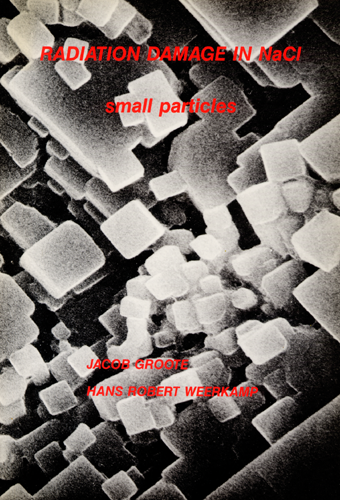 |
From the publication:
GENERAL INTRODUCTION

In the Netherlands, the discussion about the disposal of high level radioactive waste
has a long history. After several discussions in Parliament and after some smaller
studies, the Ministry of Economic Affairs initiated a major research program in the
mid eighties, called the OPLA research program (OPslag te LAnd; disposal on land).
This OPLA-project forms part of a research project called ILONA (Integraal
Landelijk Onderzoek Nucleair Afval; integral national research nuclear waste). The
aim of OPLA is to investigate the possibilities of the disposal of radioactive waste
in on-shore stable geological formations. Especially the saltdomes in the northern
provinces of the Netherlands have been mentioned as possible sites.

Several research institutes have co-operated in this matter. In Groningen research
has been carried out on radiation damage in rock-salt. We have reported upon the
results of our experiments to the Ministry of Economic Affairs (1.1-1.5].

In this thesis, we will present a model description of the formation of radiation
damage in rock-salt and we will report upon the results of experiments on irradiated
rock-salt. After presenting the experimental and theoretical results, a comparison
between the two will be given.

We have studied the effects of the dose, dose rate and irradiation temperature
together with effects of impurities and impurity concentration on the formation of
radiation damage. In order to investigate the influence of all these parameters, we
used a van de Graaff electron accelerator to irradiate a large number of samples
(chapter 5 ). From the first irradiation run in the spring of 1987, until the last run
in the beginning of 1990 we have irradiated about 12.000 crystals. Out of this huge
amount of crystals almost 10.000 samples have been measured with Differential
Scanning Calorimetry (DSC). Nearly 3.000 optical measurements have been
performed. Several other crystals have been investigated by means of alternative
experimental techniques, such as Raman scattering, ThermoLuminescence
spectroscopy (TL), Electron Spin Resonance (ESR) and Electron Microscopy
(SEM and TEM).
This publication is only available at Laka on paper, not as pdf.
You can borrow the publication or request a copy. When we're available, this is possible for a small fee.