
Publication Laka-library:
Insurance for the nuclear industry (1980)
| Author | American Nuclear Insurers |
| Date | March 1980 |
| Classification | 6.01.0.30/03 (LIABILITY / INSURANCE / LEGISLATION) |
| Front | 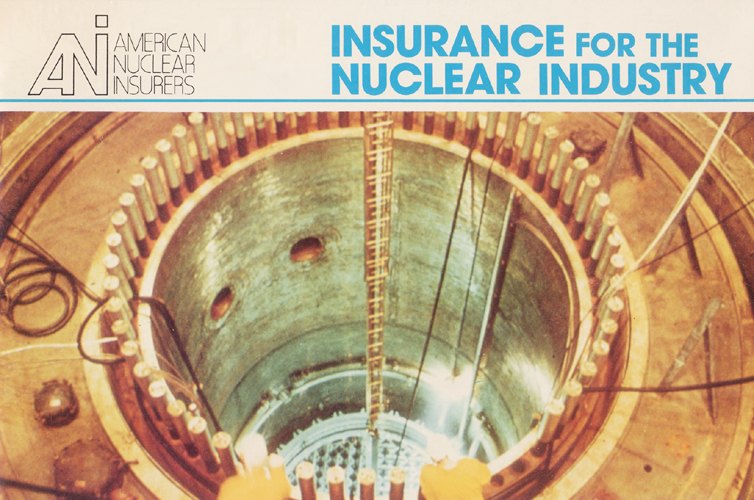 |
From the publication:
ANI INTRODUCTION

The era of commercial nuclear power in the United States officially began
when Congress passed the Atomic Energy Act of 1954. Three years later, the
government began operation of a demonstration commercial nuclear power
plant -small compared to facilities being built today - beside the Ohio River
at Shippingport, Pa.

By early 1980, 72 nuclear power plants had been licensed to operate in the U.S.
with scores more ordered, under construction or planned. Nuclear power has the
potential to supply nearly one-half the nation's electrical capacity by the year 2000.

To provide for the insurance needs of the operators of nuclear reactors, related
facilities and other nuclear technologies, and their suppliers, liability and property
insurance companies created special "pools." A pool is a group of companies which
pledges assets that together provide resources to insure risks of a size which would
be beyond the financial capability of a single company.

American Nuclear Insurers, in which approximately 140 stockholder-owned liability
and property insurance companies participate, is the largest such pool. Formerly
known as NEL-PIA, it was formed in 1974 through the merger of two organizations -
the Nuclear Energy Liability Insurance Association (NELIA) and the Nuclear Energy
Property Insurance Association (NEPIA) - both of which began writing nuclear
insurance in 1957. Its new name, American Nuclear Insurers, was adopted early
in 1978.

ANI works closely with two other insurance pools – the Mutual Atomic Energy
Reinsurance Pool (MAERP) and the Mutual Atomic Energy Liability Underwriters
(MAELU). Together, the three are known as the "nuclear insurance pools." To
achieve maximum insurance capacity, ANI and the mutual pools combine their
resources through reinsurance agreements with each other.

As of January, 1980, the three pools had the capability to provide up to $490 million
(including $30 million contingent liability) in insurance coverage for a single risk.
This figure, referred to as "capacity," is more than three times the amount available
when the nuclear insurance pools started in 1957; at that time capacity was $120
million. ANI provides about 78 per cent of industry capacity and the mutual pools
about 22 percent.

A large part of the $490 million capacity - more than 48 percent in 1980 - is
reinsured overseas by foreign nuclear insurance pools and by individual
reinsurers and reinsurance syndicates.
This publication is only available at Laka on paper, not as pdf.
You can borrow the publication or request a copy. When we're available, this is possible for a small fee.