
Publication Laka-library:
The Uranium Curse - The Northern Niger’s suffering from its wealth (2008)
| Author | Tchinaghen Association |
 | 5-24-0-00-03.pdf |
| Date | 2008 |
| Classification | 5.24.0.00/03 (NIGER) |
| Front | 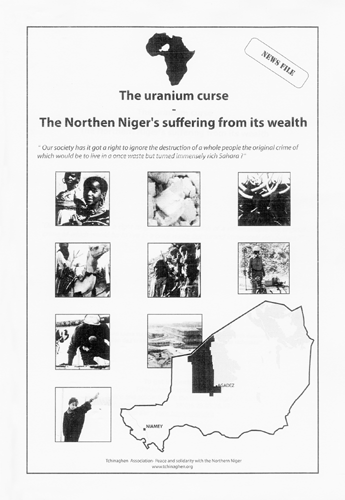 |
From the publication:
          LONG DISTANCE NOMADISM SPACES ARE FADING


                                           Northern Niger was an integral part of the
                                           Sahelian-Saharan region which was co-inhabited
                                           by several autochthonous nomadic groups
                                           (sedentary or otherwise) who lived according to
                                           traditional, ancestral rules, such as the Arabs,
                                           Chawis, Kountas, Moors, Woodaabe Fulani,
                                           Tuaregs, Tubus, and so on.

                                           The European colonizers, newly-independent
                                           governments and nation states who have been
                                           appearing, have definitively been transforming
                                           the region’s uniqueness into a mosaic of
                                           territories which were already outlined during the
                                           Conference of Berlin (1884-1885) and definitively
                                           confirmed by the African unity Organisation
                                           Charter in its preamble and articles II and III
                                           (Addis- Abeba 1965).

Today, Northern Niger and its populations live in a mutation, indeed in an exponential
economic revolution. The exploitation of different underground resources increasingly
reduces the possibilities of traditional life and pastoral economy.

In Niger, autochthonous communities are in danger

Tuaregs of Northern Niger, at least some of them, seriously recognize the danger that looms
in their otherness. For some, it is already dying. Historically, the Tuaregs- who are Berbers-
have been dispersed among a vast territory which spans across the present-day borders of
Algeria, Burkina, Libya, Mali and Niger. The first migrants originated from the gulf of Syrte,
from the oasis of Aoudjila. Between the eleventh century and the beginning of the
nineteenth century, in successive waves, the different confederations of Tuaregs and the
tribes which constituted them came to occupy new territories. After having conquered new
areas, they established that which could be considered to have been their zone of influence:
the Kel Ahaggar in Algeria, the Oudalan in Burkina-Faso, the Kel Ajjer in Libya, the Kel
Adghagh, the Iullemmeden and the Kel Ataram in Mali, the Kel Ayr, the Iullemmeden, the
Kel Dinnik, the Tuaregs from Damergou, the Kel Gress, the Tuaregs from the Niger river and
from Gourma in Niger.

The apprehension and the appreciation for the land to the detriment of marked territorial
property, the Tamajeq language identifying and unifying, the handwriting of the Tifinagh,
the power games and opposition, the socio-economic structures with their pronounced
hierarchical organization and the affirmed role of women, the pastoral traditions and the
caravan commerce, the acts of bravery and the sense of honour were for centuries the
intangible bonds of a large human community, which now, for Niger, resists with difficulty
the contemporary factors of destabilization and marginalization.