
Publication Laka-library:
The Pacific: Nuclear Testing and Minorities (1991)
| Author | E.Weingartner, Minority Rights |
| Date | 1991 |
| Classification | 4.26.0.00/06 (PACIFIC - GENERAL) |
| Front | 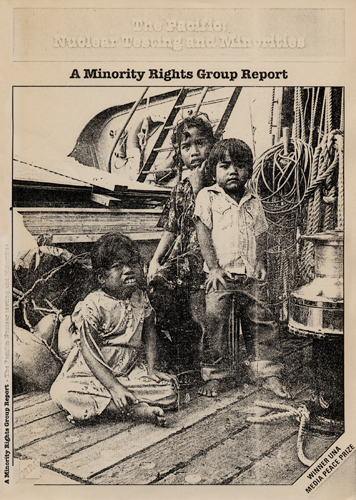 |
From the publication:
PREFACE

'No government has ever been honest enough nor has the cynical frankness to
admit that its nuclear testing entails health hazards. No government has ever
hesitated to expose other people - particularly if they are small and defenceless -
to these dangers. The Americans exploded their most powerful bombs among the
inhabitants of the Marshall Islands, the English used Christmas Island, surrounded
by atolls people by Polynesians. The Russians preferred to make their tests among
the peoples of Siberia. The Chinese government chose a region inhabited by
Tibetans and Mongols. The French first exploded their bombs in Africa and are
now ready to do so in our islands …'

The Minority Rights Group has long been concerned with the human rights of the
Pacific peoples. It has published reports on specific peoples and situations and
testified at the UN in New York and Geneva and before the US Congress. It became
apparent that major issue which affects all Pacific peoples are nuclear testing and
militarization. Therefore Minority Rights Group invited Erich Weingartner to write
this report, because of his considerable expertise in the area and his links with the
Christian churches of the Pacific who are one of the strongest regional organizations
protecting the rights of Pacific peoples.

The Pacific: Nuclear Testing and Minorities does not focus on one ethnic, religious,
linguistic or cultural minority. Erich Weingarnter argues persuasively that the peoples
of the Pacific islands, in most cases a majority in their own lands, are, in effect,
powerless minorities when faced with the economic strength, military might and
political domination of the great power states which determine their lives. They are
members of one of the poorer regions of the world, yet one which is potentially rich
in resources. Despite their former self-sufficiency most Pacific states and territories
are dependent on outside aid - which is often inappropriate, elitist and short-term.

The vast distances and sparse populations of the Pacific have been seen as making
them ideal for the military testing, storage and disposal of nuclear, chemical and
biological weapons by great powers. During World War II the Pacific was a major
battle ground. After the war it became a nuclear testing ground for the US in the
Marshall Islands and for the UK in Australia and Christmas Island. In the mid-
1960s the French government began its nuclear programme in French Polynesia -
a programme which continues with underground tests at Mororoa and Fangatoufa
Atolls despite widespread international protest. Nuclear testing is almost certainly
responsible for the abnormal deaths and sickness which now affect the populations
of the test areas. Yet there have been few independent and open medical tests on
the peoples and environment affected and, until recently in a few instances,
compensation has been derisory.

Nuclear testing must be seen as a violation of the minority rights of the Pacific
peoples. They did not choose for their homes to be test sites; they did not know
and were not warned of the possible consequences of testing, they could not
prevent them; and today they are paying the terrible and still largely unknown
price in radiation-related diseases. Today the Pacific peoples face new threats of
contamination from incineration of chemical and biological weapons at Johnston
Atoll. The social and environmental costs of militarization have been deadly ones.
This publication is only available at Laka on paper, not as pdf.
You can borrow the publication or request a copy. When we're available, this is possible for a small fee.