
Publication Laka-library:
Project Crested Ice (1970)
| Author | |
| Date | 1970 |
| Classification | 3.03.0.00/04 (GREENLAND) |
| Front | 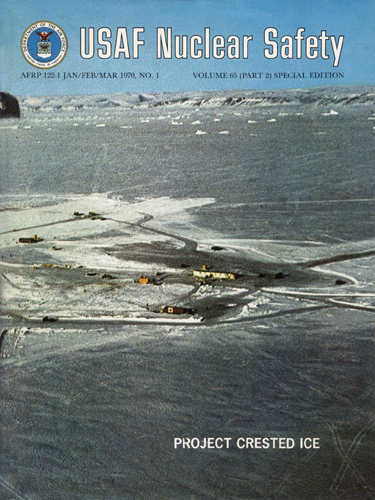 |
From the publication:
FOREWORD

GREAT technological accomplishment imposes great responsibility. Nowhere is this
responsibility made more apparent than when an accident involving an advanced
development poses a possible threat to people whose only involvement is that of
proximity to the scene of the mishap. A potential catastrophe tests-as nothing else
will-the desire to cooperate, to exert exceptional effort, and to devise new measures
for averting disaster.
Our nuclear weapons can he activated only after a prescribed sequence of actions
is followed. Because of their awesome destructive power, however, any accident
involving them rightfully receives maximum attention. On January 21, 1968, a B-52
bomber carrying four nuclear weapons crashed on the sea ice off the shore of Thule,
Greenland. Both the aircraft and the weapons disintegrated on impact. There was, of
course, no nuclear explosion since the design of the weapons precluded any nuclear
reaction. Nevertheless, limited contamination resulting from the dispersed
radioactive material from the weapons had to he controlled and removed, as
did the aircraft debris.
A major disaster was turned into a classic example of international cooperation at
governmental, scientific, and local levels. During the ensuing months, the Danes and
Americans at Thule provided a striking example of international teamwork. The
seemingly insurmountable task of recovering and removing all traces of the accident
proves again that truth may he stranger than fiction-and fully as exciting. This issue
has been chosen to provide a condensed hut complete summary of details of this
true modern saga of international cooperation-by the people who were there.
This publication is only available at Laka on paper, not as pdf.
You can borrow the publication or request a copy. When we're available, this is possible for a small fee.