
Publication Laka-library:
Nuclear Con-Fusion: The National Ignition Facility (1998)
| Author | Tri-Valley CAREs, Paul Carroll |
| Date | September 1998 |
| Classification | 3.01.8.45/03 (UNITED STATES - SITES - LAWRENCE LIVERMORE NATIONAL LAB. (LLNL)) |
| Front | 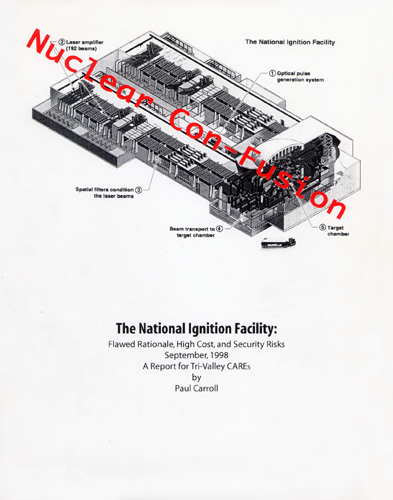 |
From the publication:
Executive summary

The U.S. Department of Energy (DOE) is planning to build and operate a
football-stadium sized laser facility called the National Ignition Facility (NIF)
at the Lawrence Livermore National Laboratory in Livermore, California. This
mega-laser will, it is claimed, focus unprecedented amounts of energy onto very
small amounts of deuterium and radioactive tritium in hopes of achieving
thermonuclear "ignition" - a sustaining nuclear fusion reaction. This is the same
reaction that takes place in the later stages of thermonuclear weapons explosions.

DOE has argued that NIF is needed to ensure that U.S. nuclear weapons continue to
be safe from accidents and reliable in their performance. This is especially critical,
DOE claims, since the United States has signed a treaty that will forever prohibit
nuclear tests.

In addition to its national security role, DOE promotes the NIF as an invaluable
scientific tool for research into fusion energy. DOE claims it is a "critical step"
in demonstrating that fusion energy is a possibility for the future.

This report investigates the many claims made for the NIF. It examines the status of
U.S. nuclear weapons with respect to safety and/or reliability, and analyzes whether
NIF is needed or could contribute to these characteristics. An analysis of how NIF
might contribute to the development of a new generation of nuclear weapons will be
covered. The implications of NIF, and the planned stockpile stewardship program at
large, for the international ratification of the Comprehensive Test Ban Treaty (CTBT)
and achieving nuclear disarmament will be discussed. The report also examines the
"energy argument" made for NIF by the DOE.
This publication is only available at Laka on paper, not as pdf.
You can borrow the publication or request a copy. When we're available, this is possible for a small fee.