
Publication Laka-library:
Rethinking Plutonium (1992)
| Author | ERF, NRDC |
| Date | April 1992 |
| Classification | 3.01.5.30/01 (UNITED STATES - GENERAL NUCLEAR WEAPONS PLANTS + CLEAN UP) |
| Front | 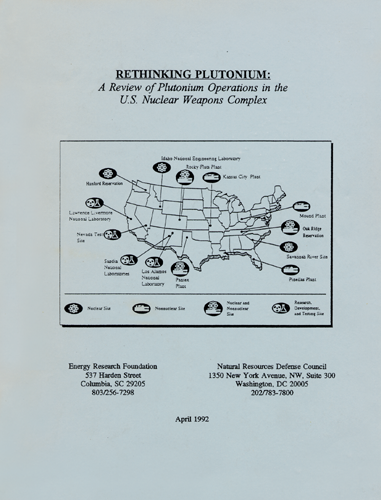 |
From the publication:
PREFACE

As a result of safety and environmental problems, the United States currently lacks
the capacity to produce nuclear warheads - a situation that has persisted for more
than two years. Moreover, for the first time since the Manhattan Project, the U.S.
has no immediate plans to produce additional warheads. Nonetheless, the Department
of Energy (DOE) is proposing a major rebuilding of the nuclear weapons complex.
   The current production hiatus provides an excellent opportunity to look beyond
DOE's proposals and fundamentally review the role of the nuclear arsenal and the
vast industrial complex which created it Many of the most important issues to be
addressed concern the facilities and operations used to produce and manage
plutonium - an extremely hazardous and long-lived element used almost solely for
nuclear weapons. A substantial portion of the nuclear weapons complex has been
devoted to plutonium operations, which have created vast amounts of waste and
contamination. Hence, it is crucial that any review of the complex's future consider
a number of questions regarding plutonium.

• Is surplus plutonium an asset or a liability?
• What plutonium processing facilities and operations, if any, will be needed in
the post-Cold War era?
• When and how will existing plutonium facilities be decontaminated and
decommissioned?

This report addresses these and other questions in an effort to stimulate a broader
dialogue before billions of dollars are spent developing a new generation of
plutonium facilities, dealing with the existing stockpiles of plutonium and plutonium-
bearing materials, and managing the vast amounts of plutonium-contaminated waste.
The report is divided into four chapters:

Chapter One reviews current plutonium operations and DOE's plans for the future.
Also discussed are the relationship between national security and the need for
additional processing, issues linked to the dismantlement of nuclear warheads, and
options for the current inventory of plutonium and plutonium-bearing materials,
including a brief discussion of proposals for the use of plutonium in commercial
reactor fuel.

Chapter Two briefly explains the production of new plutonium and the types
of plutonium processing.

Chapter Three describes the primary plutonium processing sites, focusing on DOE's

Chapter Four contains several recommendations.
This publication is only available at Laka on paper, not as pdf.
You can borrow the publication or request a copy. When we're available, this is possible for a small fee.