
Publication Laka-library:
Nuclear Power Safety Report 1979-1985 (1986)
| Author | Critical Mass Energy Project |
| Date | May 1986 |
| Classification | 3.01.0.20/21 (UNITED STATES - SAFETY) |
| Front | 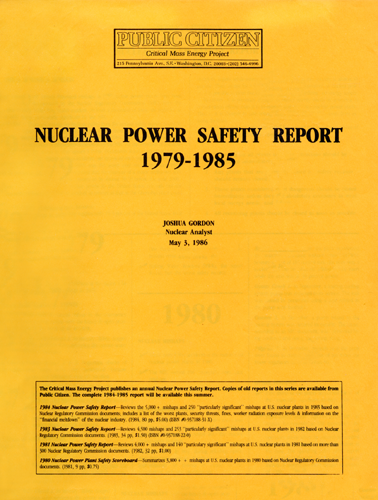 |
From the publication:
PUBLIC CITIZEN'S
CRITICAL MASS ENERGY PROJECT

NUCLEAR POWER SAFETY REPORT
1979-1985

BY JOSHUA GORDON

Over twenty thousand mishaps at U.S. nuclear power plants have been documented
by the Nuclear Regulatory Commission (NRC) since the 1979 Three Mile Island
accident. At least a thousand of these arc regarded as being particularly significant
by the NRC.
These are among the findings culled from the annual safety reports issued by Public
Citizen's Critical Mass Energy Project between 1979 and 1983 and the preliminary
findings of its forthcoming 1984/1985 study. The finding; are based on hundreds of
documents obtained from the NRC via the Freedom of Information Access to other
agency's Public Documents Room, and other source.
The number of nuclear incidents has increased each year and, according to
Congressional estimates, 1985 was the worst year on record since 1979. Moreover,
the NRC has estimated that the chances of a major meltdown accident at a reactor
in this country to be almost 50:50 before the year 2000.
Thus, not only is nuclear power in the United States not safe but the evidence
shows that an accident as serious at that at the Chernobyl plant could happen here.
We do have a choice, however.
Nuclear power presently supplies only 15.5 percent of the United States' total
electricity supply while excess generating capacity in this country is almost 35
percent. Thus, except for a few regions particularly dependent on nuclear power,
it is possible to close nuclear plants without jeopardizing our energy supply.
Moreover, it is presently cheaper to satisfy energy needs by investing in
conservation efforts than it is to operate and maintain nuclear power plants.
That is, it is cheaper to save energy than it is to produce it-even from existing
facilities.Accordingly, Public Citizen has called for a rapid and orderly
phase-out of nuclear power in this country Specifically:

1. Licensing on all plants under construction should be suspended immediately;

2. Any plants that are currently dosed for safety reasons should remain dosed;

3. Those plants considered most dangerous should be dosed immediately unless
they are absolutely necessary to meet load energy needs; and

4. All remaining plants should be dosed as soon as possible.
This publication is only available at Laka on paper, not as pdf.
You can borrow the publication or request a copy. When we're available, this is possible for a small fee.