
Publication Laka-library:
1979: 2,000 nuclear mishaps (1980)
| Author | Critical Mass Energy Project |
| Date | July 1980 |
| Classification | 3.01.0.20/17 (UNITED STATES - SAFETY) |
| Front | 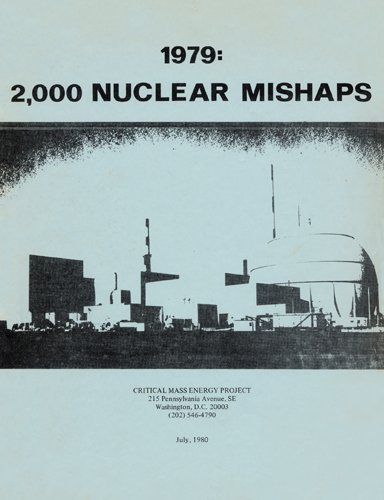 |
From the publication:
Introduction

When the first large nuclear power reactors were mere blueprints, the old Atomic
Energy Commission decided to rely on scientific and mathematical engineering
predictions as acceptable guides to plant design and construction. Reactor
experience was not then a major factor.
Yet as the number of reactor-years of actual operation increased, the AEC and its
successor agency, the Nuclear regulatory Commission, still never undertook a
regular and systematic review of the types, frequency and origins of technical
failures to verify their earlier assumptions and identify unforeseen problems.

As the NRC's own Special Inquiry Group investigation of the Three Mile Island
accident concluded in 1980, "this process of learning from experience has not yet
been seriously undertaken by the NRC or the industry."
But just because no one has heard the tree fall in the forest doesn't mean that it is
still standing tall and erect. Utilizing a compilization of actual reports from utility
companies to the NRC as logged by the agency during the calendar year 1979, the
Critical Mass Energy Project has pieced together one of the first "trend reports" of
actual nuclear operating experience.

It is a troubling profile. The following report discloses that Three Mile Island was
not the only accident of 1979. More than 2,300 mishaps occurred that year.

This study analyzes "event reports" filed with the Nuclear Regulatory Commission
(NRC) during 1979 by the operators of 68 reactors. The findings indicate that atomic
power generation includes a system of frequent human error, chronic defects in
critical safety equipment, and unsolved problems in the basic design of many plants.
Claims by the nuclear industry that these plants can provide reliable, safe and
abundant electricity are seriously undercut by this track record.

Possibly most significant is the fact that it seems possible to identify particular
"problem plants" -reactors where all types of classified "events" occur at an above
average rate. The Crystal River plant in Florida, for example-site of the serious
loss of instrumentation accident in February, 1980, had one of the worst
performance records in 1979.

The mistakes reported by utilities ranged from relatively minor - such as a
misplaced water sample-to serious-such as cracked control rods necessary to
harness the powerful atomic reactions in the reactor core. But whatever their
specific impact, taken as a whole these repotted events point to a technology
pocked with serious operational defects.

Although the largest number of problems are attributed to equipment failure, more
than one out of every four accidents was due to human error-23 percent of which
were the fault of senior operators. Many could have been the single trigger for
another Three Mile Island accident-or worse.
This publication is only available at Laka on paper, not as pdf.
You can borrow the publication or request a copy. When we're available, this is possible for a small fee.