
Publication Laka-library:
Gamma-spectrometry analyses on Ukrainian Mushrooms (1999)
| Author | CRII-RAD |
| Date | April 1999 |
| Classification | 2.34.8.12/01 (CHERNOBYL ACCIDENT - CONSEQUENCES SURROUNDINGS - CONTAMINATED FOOD) |
| Front | 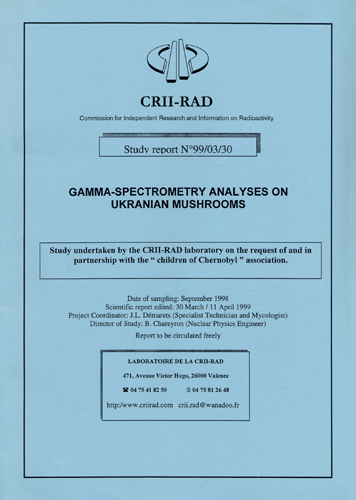 |
From the publication:
CRII-RAD Report
UKRAINE99

INTRODUCTION

Mushrooms are known for their ability to concentrate a number of substances
present in the soil.

The part of the mushroom above ground, which is eaten (the carpophore), has only a
fleeting existence (from a few days to a few weeks for the majority of species). The "
mushroom plant" is also composed of an underground part, the mycelium. This
consists of a network of fibres spread across an area of up to about one hundred
square metres. Its lifespan goes from a number of years to more than one century for
certain species. This network constitutes an effective filter for substances contained
in the soil. When it develops, the carpophore mirrors the contamination in the
mycelium.

The analyses carried out in France by the CRII-RAD laboratory in 1997 and 1998,
that is to say more than ten years after the Chernobyl disaster, show that for certain
species of mushroom and for certain areas, the level of Caesium 137 contamination
have remained at or above the levels permitted for importation of foodstuffs.
The " Children of Chernobyl " association wished to have a study carried out into the
radioactive contamination of mushrooms collected in the UKRAINE, close to villages
still inhabited (outside the 30 km exclusion zone), in order to inform local consumers
of the eventual risks inherent in eating certain types of mushroom and, as a result,
to advise them to collect less contaminated species.
This publication is only available at Laka on paper, not as pdf.
You can borrow the publication or request a copy. When we're available, this is possible for a small fee.