
Publication Laka-library:
Torness, keep it green (1979)
| Author | Michael Flood |
| Date | 1979 |
| Classification | 2.05.8.50/01 (UNITED KINGDOM - TORNESS) |
| Front | 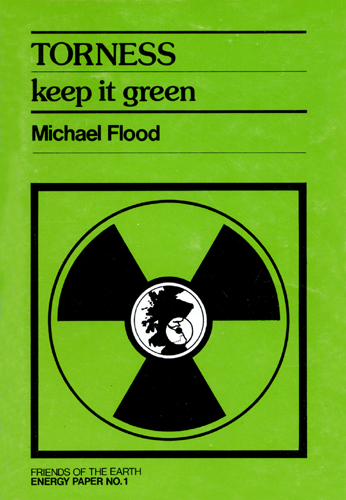 |
From the publication:
TORNESS FOOLISHNESS

On May 24th 1978, Bruce Millan, the Secretary of State for Scotland, gave consent
for the construction of a nuclear power station at Torness Point in East Lothian.
This decision marked the beginning of a process that could turn Torness into one
of Europe's largest nuclear complexes.

Torness Point lies five miles to the south of Dunbar, on the Firth of Forth. It is an
area of scientific interest on a rocky coastline of outstanding scenic beauty. The
220 foot high reactor hall and the giant pylons for the 400 kilovolt transmission
lines will destroy the character of the area and threaten tourism. Over 150 acres of
prime agricultural land will be lost directly to the power station and more will be
needed to provide houses, roads and other services.

In 1974 a public inquiry lasting a mere eight days was held in Dunbar. It was a
travesty. The inquiry Inspector - the "Reporter" - took no account of the potential
for conservation measures nor the impact of higher prices on electricity demand.
The South of Scotland Electricity Board failed to say what kind of reactors were
to be built at Torness; what size they would be; and when they were to be built.
Despite this, however, planning permission was granted for two nuclear power
stations with up to eight reactors.

Not surprisingly public opposition to this nuclear nonsense has grown as details of
the proposal have slowly leaked out. In May 1978, 4,000 people gathered in Dunbar
to march to the site. A later demonstration saw 30 tractors and trucks drive in
procession from Torness to Edinburgh. By August the opposition had grown
stronger and the Lothian Regional Council called upon Bruce Millan to reopen
the public inquiry.

He refused. In September he approved the capital investment for two 660 megawatt*
Advanced Gas-cooled Reactors (AGRs) for the power station.

* A Megawatt is a million watts.
This publication is only available at Laka on paper, not as pdf.
You can borrow the publication or request a copy. When we're available, this is possible for a small fee.