
Publication Laka-library:
On Site ... Out of Sight?
| Author | Nuclear Free Zones Scotland |
| Date | |
| Classification | 2.05.4.10/23 (UNITED KINGDOM - WASTE - NIREX/NDA DECOMMISIONING) |
| Front | 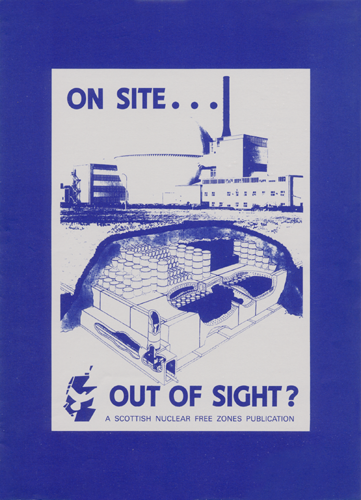 |
From the publication:
In March 1989 a company called United Kingdom Nirex Limited staged a bid to
find an 'Out of Sight; Out of Mind' solution to the problem of Britain's nuclear waste.
As a result, Dounreay in Caithness is one of two sites to be investigated with a view
to dumping nuclear waste deep underground. There are also another 10 undisclosed
sites, several of which are believed to be in Scotland, which are held in reserve for
further investigation if necessary.

This leaflet explains the background to waste dumping in the United Kingdom and
outlines the potential risk to the people of Caithness, the Highlands and Islands and
Scotland as a whole from the Nirex proposals and is a response to some of the
points made by Nirex in their publications The Way Forward and Going Forward.

1. INTRODUCTION
Most nuclear waste in the United Kingdom is produced as a result of the generation
of electricity by nuclear power and the reprocessing of our own and foregoing spent
nuclear fuel. Much smaller quantities arise from industrial and medical sources.
Radioactive waste also arises as a result of military activities (including weapons
production). Without careful and responsible control, all of these wastes could pose
a serious threat to health and to the environment for a time longer than life itself
has existed on Earth.

There are two possible approaches to the nuclear waste issue; indefinite storage or
dumping. Indefinite storage involves careful management of waste in specially
designed buildings at existing reactor sites. The waste packages would be constantly
monitored and packages found to be faulty would be removed from store, and
repackaged before being re-admitted to store. This is the approach favoured by most
environmental groups and the majority of planning authorities in Scotland. The main
disadvantage of this system is that it would be the more expensive option, as it
would require permanent manning and active management for all time.

'Dumping' on the other hand, frequently described as 'disposal' by the nuclear
industry, would involve digging out underground 'caverns', lowering the waste into
them and then, when the caverns are full, filling them up with concrete or other
material, sealing the access tunnels and hoping that all will be well. The main
advantage is that, despite the high capital cost of digging the caverns, the dump does
not need to be manned in the long-term, so that it is a less expensive option - the
Government favours the latter, cheaper approach.

United Kingdom Nirex Limited has been given the job of dealing with solid
intermediate and low-level nuclear wastes in accordance with government policy of
the cheaper deep-disposal option. Nirex is a company entirely owned by the nuclear
industry. 42.5% of the equity is held by British Nuclear Fuels, the company who
operate the Sellafield plant. Another 42.5% is held by the English Central Electricity
Generating Board. The remaining 15% is split evenly between the United Kingdom
Atomic Energy Authority (operators of the Dounreay Establishment) and the South
of Scotland Electricity Board. The Government holds a 'Golden Share' in Nirex.
This publication is only available at Laka on paper, not as pdf.
You can borrow the publication or request a copy. When we're available, this is possible for a small fee.